- Reports suggest Canary Capital has filed a Form S-1 with the SEC for a potential SUI ETF, though official confirmation is pending.
- If approved, the ETF could boost SUI’s institutional adoption and liquidity, potentially impacting its price trajectory.
- SUI remains in a downtrend, with key support at $2.20–$2.00 and resistance near $2.40–$2.70.
SUI’s potential exchange-traded fund (ETF) debut is drawing attention after reports surfaced that Canary Capital has filed a Form S-1 with the U.S. Securities and Exchange Commission (SEC).
While the filing hasn’t been officially confirmed, recent registrations in Delaware hint that a crypto-focused ETF could be in the works.
What Other Crypto ETFs is Canary Capital Eyeing?
Canary Capital has been actively pursuing crypto ETFs, with reported filings for Hedera (HBAR), Litecoin (LTC), XRP, and Solana (SOL) in addition to SUI. If approved, these ETFs would give institutional investors regulated access to these assets, potentially increasing market activity and adoption.
Alongside growing talk, analysts believe a SUI ETF could be a big deal, attracting significant capital inflows similar to Bitcoin and Ethereum ETFs. Past data shows that regulatory approval of ETFs often leads to market rallies, as seen with Bitcoin’s ETF approval earlier this year.
SUI’s Market Outlook: Can It Overcome Bearish Pressure?
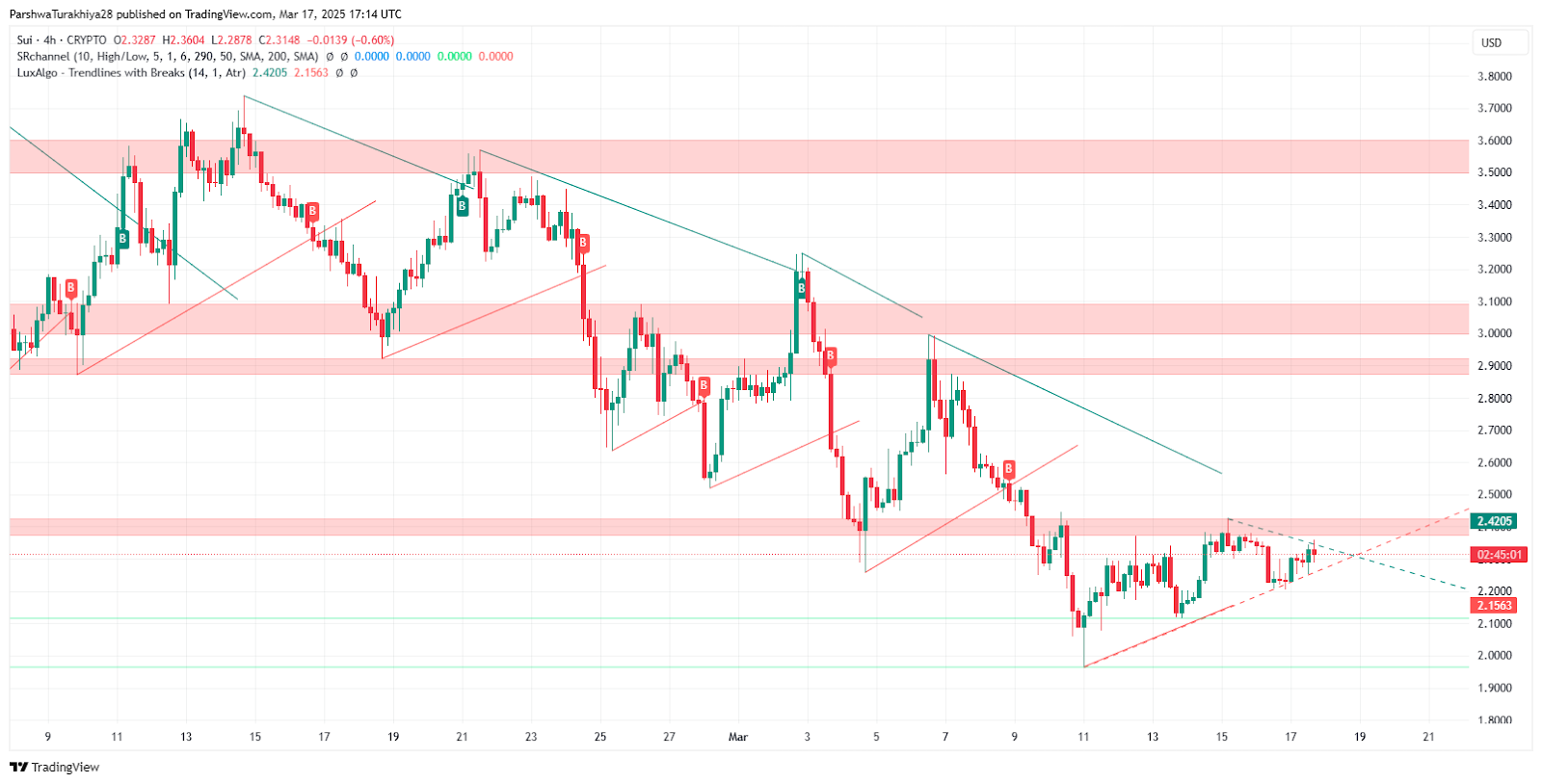 SUI Price Dynamics (February 2025 – March 2025)
Despite the ETF speculation, SUI remains in a downtrend, facing consistent resistance from a descending trendline on both daily and 4-hour charts.
The token is currently trading around $2.31, struggling to get above the important $2.40 level, which lines up with short-term resistance.
Technical indicators suggest traders are being cautious. The 20 EMA at $2.29 and 50 EMA at $2.33 indicate weak short-term momentum, while the 100 EMA ($2.48) and 200 EMA ($2.78) are acting as strong overhead resistances. If SUI can’t break above these levels, further price drops are still possible.
The Relative Strength Index (RSI) is at 52.52, showing neutral momentum. A move above 60 could signal bullish strength, while a drop below 45 would suggest more selling pressure. At the same time, Bollinger Bands suggest low volatility, with the price staying between $2.22 (support) and $2.41 (resistance).
Can the ETF News Help SUI’s Prospects?
Although SUI’s technical outlook remains bearish, the growing institutional interest from Canary Capital’s ETF filing could provide a catalyst for price recovery.
A breakout above $2.40 could push SUI toward $2.65–$2.70, while sustained momentum could challenge the $3.17 resistance level.
However, if negative sentiment continues, SUI risks dropping toward the $2.00–$2.05 support zone, with a worst-case scenario targeting $1.50–$1.80. Market participants should watch trading volume and broader crypto trends closely to see if the ETF news can outweigh the current downtrend.
Disclaimer: The information presented in this article is for informational and educational purposes only. The article does not constitute financial advice or advice of any kind. Coin Edition is not responsible for any losses incurred as a result of the utilization of content, products, or services mentioned. Readers are advised to exercise caution before taking any action related to the company.