
Fed Meeting This Week: What to Expect from Bitcoin?

- Expectation of maintaining interest rates.
- Focus on the effects of Trump's tariff policies.
- The next Fed meeting (FOMC) will be on March 18 and 19.
As we approach this week’s Federal Reserve meeting, the market is expecting the US central bank to keep interest rates steady. However, investors and financial analysts are keeping a close eye on any potential deviation from this forecast, which could have significant effects on cryptocurrency markets, especially Bitcoin.
In the United States, the next FOMC (Federal Open Market Committee) meeting will be held on March 18 and 19.
Currently, futures for major US indices are showing mixed performance. While S&P 500 futures showed a recovery, Dow Jones Industrial Average futures registered a slight decline. Meanwhile, Nasdaq 100 futures rose slightly. In the cryptocurrency space, Bitcoin remained stable, with the price hovering around $82.993,92, without major changes in the last 24 hours.
US Treasury Secretary Scott Bessent has expressed a relatively calm view of recent market volatility, stressing that “corrections are healthy” and that there are “no guarantees” against a possible recession. His remarks come as the market anticipates the Fed keeping interest rates unchanged.
However, if the Fed opts to hike rates, we could see Bitcoin fall below $80.000, as investments in riskier assets such as cryptocurrencies tend to be less attractive in higher interest rate scenarios.
On the other hand, a possible reduction in interest rates could boost Bitcoin to reclaim the $90.000 level. Lower interest rates tend to devalue fiat currency and encourage investment in alternative assets, such as Bitcoin, increasing its attractiveness.
In addition, investors are eagerly awaiting the “dot plot,” a chart that reveals individual Fed policymakers’ projections of future interest rates. The last update of that chart indicated an expectation of two rate cuts this year, with the adjustment influenced by Trump’s expected economic policies.
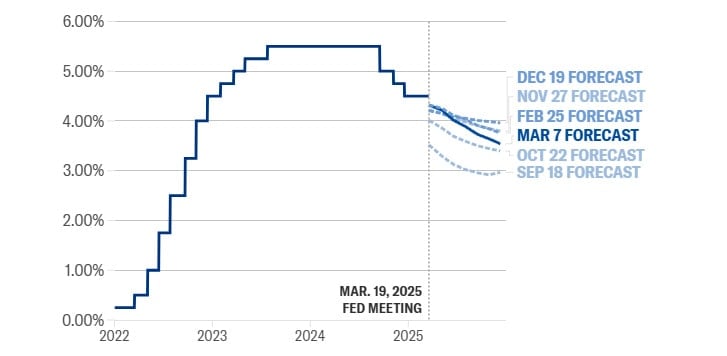
As Trump’s new policies, including an aggressive series of tariffs, begin to take effect, there is growing uncertainty about how the Fed will adjust its outlook for economic growth and inflation. Former Kansas City Fed President Esther George said central bank policymakers may be more concerned about modeling the impact of these tariffs on economic growth.
Market reactions already reflect these uncertainties, with a significant drop in the last month, followed by a partial recovery. Markets are anticipating up to three rate cuts over the course of the year, highlighting ongoing concerns that the president’s policies could suppress economic growth.
Disclaimer: The content of this article solely reflects the author's opinion and does not represent the platform in any capacity. This article is not intended to serve as a reference for making investment decisions.
You may also like
The script at the end of 2018: The Federal Reserve continued to raise interest rates, US stocks plunged 20% from the September highs, forcing the Federal Reserve to "pivot" in January.
Goldman Sachs' head of trading believes the current US stock market is repeating the scenario of late 2018, with monetary tightening and equity market pressure. The Goldman Sachs Financial Conditions Index has tightened by about 8 points in two weeks, reaching the highest level in a year. The selloff has broadened from tech stocks to defensive sectors. Gold and equities are declining simultaneously, possibly indicating investors are selling assets to raise cash, making gold a key indicator for observing liquidity stress.

Goldman Sachs Trader “Revisits the 2018 Playbook”: Still Clearly Remembers “On December 24th, Clients Asked Why the Market Dropped So Much—And I Had No Idea”
Brian Garrett pointed out that the current adjustment in the US stock market is similar to the sharp decline in Q4 2018: the S&P 500 has already experienced 42% of the corresponding drop, and the VIX is approaching its peak just before Christmas. If history repeats itself, the bottom of this cycle may appear in January next year. However, the credit market and Federal Reserve policy have yet to provide clear signals of a bottom.
Anthropic (ANT.US) nearly “broke issue price,” but Claude knocks on the doors of “the highest peak in mathematics”! 17 million lines of Lean code used to write a candidate proof for the Riemann Hypothesis
On November 20th, Eastern Time, on its second day of trading, Anthropic's intraday price dropped to a low of $83.05, just 5 cents above the offering price of $83, and finally closed at $88.91, a decline of 8.50%. On the same day, the company's mathematician Levant Alperg announced on his personal website that he and Claude had found a candidate proof for the Riemann hypothesis, which has puzzled the mathematics community for 167 years, and released about 17 million lines of Lean formalized code.

As US stocks plummet, the parent company of GTA 6 rises against the market! First-day sales hit a record $3.79 billion; Wall Street shifts focus to next-generation GTA Online.
According to Rentrak data, the global box office of "Grand Theft Auto VI" has also surpassed that of "Avengers: Endgame," the highest-grossing film of all time, which has a global box office of approximately $2.94 billion.

Crypto prices
More


