
Ethereum’s Market Dominance Hits 2020 Lows: Analysts Discuss Key Factors

Ethereum is facing significant price decline due to factors like Layer-2 fragmentation, technical flaws, and regulatory uncertainty, raising concerns about its future growth.
Ethereum (ETH), the world’s second-largest cryptocurrency by market capitalization, is experiencing a severe downturn, marking what could be its worst quarter in history.
It comes amid a broader market lull, although for Ethereum, the outlook is concerning as the largest altcoin by market cap metrics continues to underperform.
Analysts Probe Ethereum Price Performance
Ethereum lost more than 44% of its value in the first quarter (Q1). Data also shows record levels of active selling over the past three months. CryptoQuant CEO Ki Young Ju ascribes this to an unprecedented wave of sell-offs.
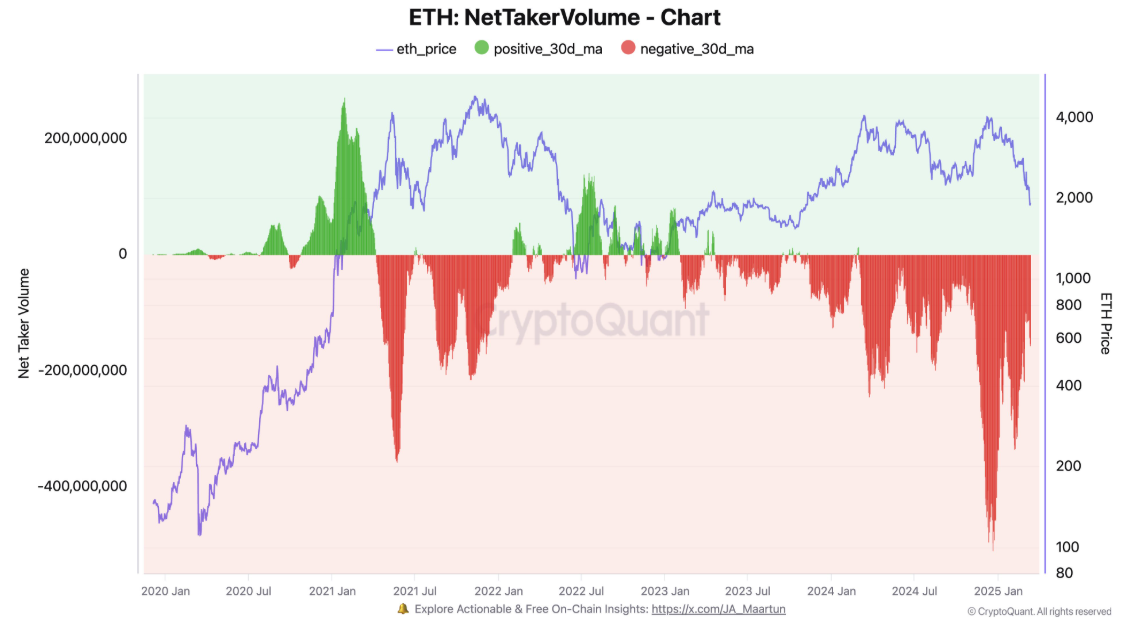 Ethereum faces record selling. Source:
CryptoQuant CEO on X
With the massive selling, Ethereum’s market dominance has significantly dropped. Data on CoinMarketCap shows it stood at 8.5% as of this writing, marking its lowest level since 2020.
This turnout prompted widespread discussions on X (Twitter) as analysts attempted to explain the cause of Ethereum’s decline.
“What exactly happened to Ethereum?” Tron founder and Huobi Global advisor Justin Sun posed.
Layer 2 Impact on Ethereum’s Decline
According to analyst Camila Russo, the primary explanation for Ethereum’s decline is the rise of Layer-2 (L2) networks. While these scaling solutions improve scalability and reduce congestion on Ethereum’s mainnet, the benefits are not adequately reflected in ETH’s price performance.
“There’s a path to fix Ethereum L2 fragmentation and horrible UX. But I still don’t see how all this L2 activity gets reflected on the Ethereum mainnet. Layer 2s are getting Ethereum security for free right now, only paying for block space, which they will pay even less for with larger blobs,” Russo explained.
This perspective suggests that while Ethereum remains central to many blockchain applications, its value capture mechanisms are flawed. This leads to a continued slide in ETH’s price despite ongoing adoption and development efforts.
Ethereum’s Technical Foundation
Beyond structural issues with L2 scaling, some Ethereum developers have expressed concerns about the blockchain’s technical foundation, which raises questions about its long-term viability.
One developer, Uncle Rockstar Developer, described Ethereum as “an absolute garbage dumpster fire.” He argued that the network has drifted far from its original promise of a decentralized world computer.
“To mask foundational failings, pointless complexity kept being added on top… which now and then rears its ugly head in hacks like the one that cost Bybit 400,000 ETH (~$1.5 billion),” he stated.
The developer also criticized Ethereum’s governance, claiming it has become a centralized startup primarily benefiting its co-founder, Vitalik Buterin.
Lack of a Compelling Narrative
Blockstream advisor Tuur Demeester said the perceived lack of a compelling narrative was another major factor contributing to Ethereum’s decline.
“It ran out of stories,” Demeester quipped.
He referenced a 2017 tweet in which he warned that cryptocurrencies reliant on novelty rather than utility would struggle. This stance hinges on the assumption that the market generates new narratives faster than Ethereum can sustain.
Regulatory Uncertainty and Institutional Hesitation
Regulatory concerns also loom over Ethereum’s future. Unlike Bitcoin, which is widely recognized as a commodity, Ethereum’s staking and yield-generating features make it vulnerable to being classified as a security.
Francisco Quartin de Macedo, a fund manager, noted that ETH’s monetary policy has become increasingly unclear since The Merge. The upgrade brought lower network activity, leading to inflationary pressures rather than the deflationary trend previously expected.
Macedo further highlighted that Ethereum lacks the strong institutional backing that Bitcoin ETFs (exchange-traded funds) approvals brought for BTC. Similarly, Bitcoin’s positioning as digital gold also adds credence to this supposition.
“TBH [to be honest] still feels like the institutional choice, just not clear what that means for the price,” Macedo remarked.
He pointed out that Ethereum’s fragmented Layer 2 ecosystem and regulatory uncertainty have deterred some investors from betting on ETH’s long-term growth.
Ethereum’s recent struggles owe to a combination of factors, including the unintended consequences of L2 scaling solutions. While Ethereum remains a crucial player in the blockchain space, its price action suggests that investors and developers are becoming increasingly concerned about its future.
Nevertheless, some analysts observe that although the Ethereum price is underperforming, ETH staking is rising. This could mean long-term confidence among some investors. However, without clear catalysts or structural changes, ETH may continue to underperform relative to other major cryptocurrencies.
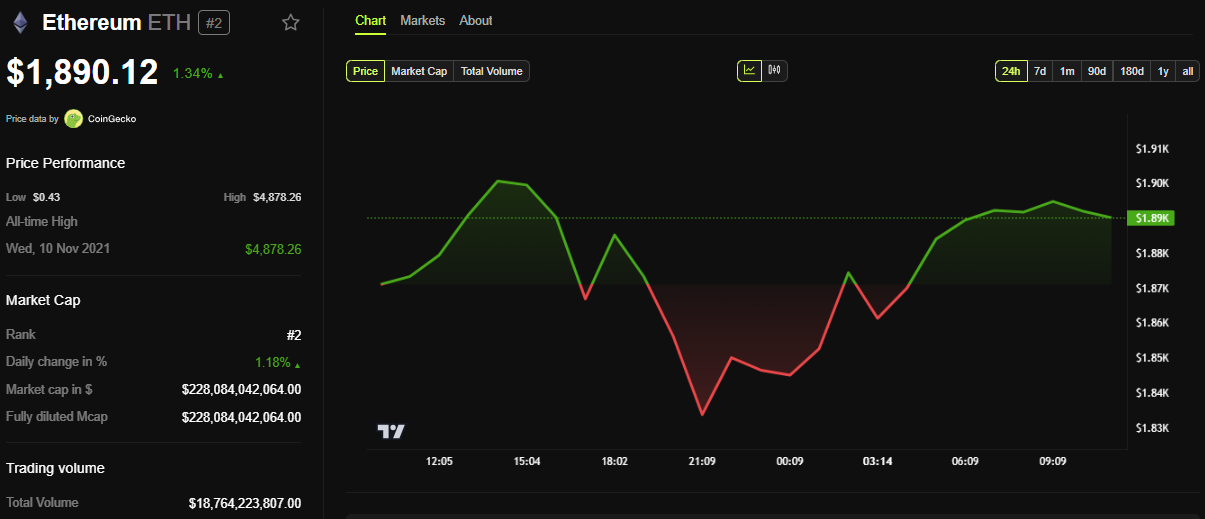 Ethereum (ETH) Price Performance. Source:
BeInCrypto
BeInCrypto data shows ETH was trading for $1,890 as of this writing, up by a modest 1.34% over the last 24 hours.
Disclaimer: The content of this article solely reflects the author's opinion and does not represent the platform in any capacity. This article is not intended to serve as a reference for making investment decisions.
You may also like
Elon Musk’s AI ambitions move to the next stage! Tesla (TSLA.US) upgrades FSD with enhanced visual perception and driving interface—can it win long-term subscriptions from car owners?
On November 21st, Tesla began rolling out the FSD V15 supervised version to the first batch of owners, and Elon Musk said the rollout would expand in December. The newly launched “Tesla Reality View” has become a trending topic because it allows owners to directly compare the real road conditions outside their window with the vehicle's next driving intentions.

US Stock IPO Analysis | Baitu Vision (BLTG.US) Rushes to Nasdaq: VR Display Business Supports the Foundation, Diversified Layout Yet to Be Verified
From a business model perspective, the core competitiveness of Byetuo Vision lies in integrating optical display technology, product design, and application development to provide customized display solutions for downstream clients.
Weekly US Equity Macro Outlook Highlights (Nov 23–27)
Crypto prices
More


