
Cardano (ADA) Might Struggle to Retain $1 Amid US Reserve Debate

ADA’s uptrend is losing strength as resistance at $1 proves tough to break. Whale activity and ADX trends suggest potential consolidation ahead.
Cardano (ADA) is down more than 6% on Thursday but remains up nearly 40% over the past seven days. After surging to $1.15 following its inclusion in the US crypto strategic reserve, ADA has struggled to stay above $1 in recent days.
Some users are now questioning its inclusion in the reserve, raising concerns about its price. With whale accumulation slowing and resistance at $1 proving difficult to break, ADA’s next move will depend on whether bullish momentum can return or if selling pressure pushes it lower.
ADA ADX Shows The Uptrend Is Still Strong, But It’s Not As Strong As Before
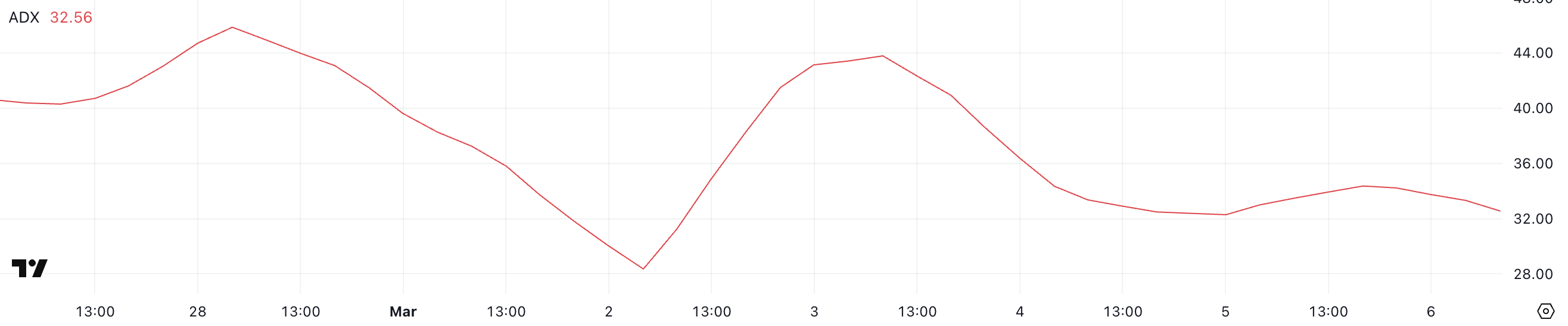
Cardano has an ADX of 32.5, down from 43.7 three days ago, following a price surge driven by ADA’s inclusion in the US crypto strategic reserve.
Despite the decline in ADX, it remains above the 25 threshold, indicating that the ongoing uptrend still has strength, though momentum has slightly weakened.
 ADA ADX. Source:
TradingView.
The Average Directional Index (ADX) measures trend strength on a scale from 0 to 100, with readings above 25 signaling a strong trend and values below 20 suggesting weak or nonexistent momentum.
With ADA in an uptrend and ADX at 32.5, the trend remains intact but may not be as strong as it was three days ago.
If ADX continues to decline, the trend could lose momentum, leading to a potential slowdown or consolidation. However, if ADX stabilizes or rises again, ADA could maintain its upward trajectory and push toward new resistance levels.
Cardano Whales Are Not Accumulating
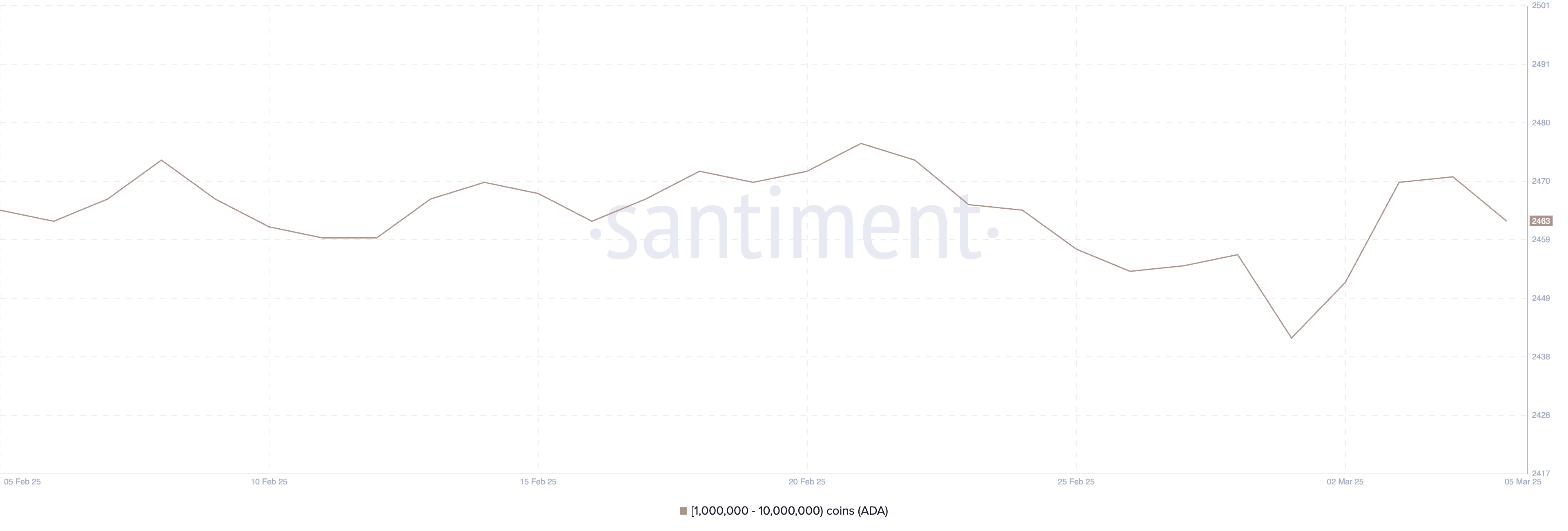
The number of Cardano whales – addresses holding between 1 million and 10 million ADA – has declined slightly in the past few days after a strong increase between March 1 and March 4, when it rose from 2,442 to 2,471.
The count now stands at 2,463, indicating that some large holders have reduced their positions following the recent surge. This may have been influenced by the crypto community questioning the inclusion of ADA and XRP in the US crypto strategic reserve.
 Addresses Holding Between 1 Million and 10 Million ADA. Source:
Santiment.
Tracking these whales is important because large holders can influence market liquidity, volatility, and price trends. A rising number of whales often signals accumulation, which can drive prices higher, while a decline suggests potential profit-taking or reduced confidence.
With the current whale count slightly below its recent surge, ADA’s recent uptrend could slow if more large holders begin selling. However, if accumulation resumes, it could support continued price gains.
Will Cardano Test $1 Soon?
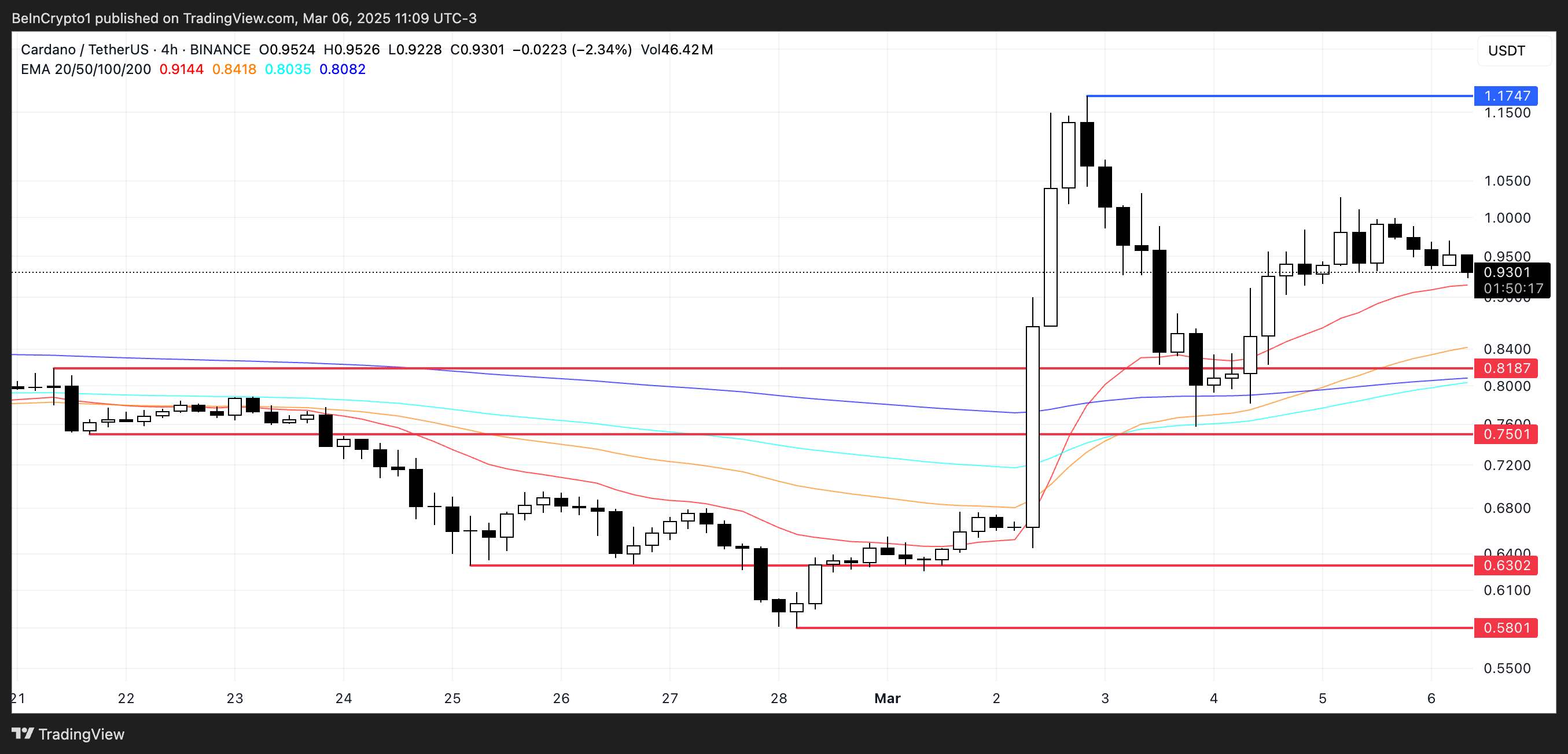
Cardano’s EMA lines indicate a bullish trend, with short-term EMAs positioned above long-term ones.
However, despite this positive setup, Cardano price has struggled to break above $1 in recent days after a sharp correction following its 71% surge on March 2. This suggests that while momentum remains intact, resistance at $1 is proving difficult to overcome.
 ADA Price Analysis. Source:
TradingView.
If the current uptrend reverses into a downtrend, ADA could test support at $0.818, with a break below that level potentially leading to $0.75. A stronger selloff could push the price as low as $0.63 or even $0.58.
On the other hand, if ADA regains momentum, it could test $1 again, and a breakout above this key resistance could send the price toward $1.17, a level it nearly reached during the March 2 surge.
Disclaimer: The content of this article solely reflects the author's opinion and does not represent the platform in any capacity. This article is not intended to serve as a reference for making investment decisions.
You may also like
Goldman Sachs Global Stock Market Outlook: AI Capital Expenditure to Peak Next Year, Earnings Growth to "Slow Down Significantly", Cloud Giants Become "Defensive Assets"
Goldman Sachs’ 2027 Global Equity Strategy points out that the AI capital expenditure boom is nearing its peak, and global profit growth will slow significantly. S&P 500 earnings growth is expected to drop from 36% to 11%, with depreciation pressures gradually emerging. However, cloud giants’ valuations have adjusted to a forward P/E of 19.7, lower than the staples sector, and are classified as “relatively defensive” assets. Goldman Sachs predicts an S&P 500 target of 8,700 points and suggests overweighting the US and Japan, while underweighting Europe.
With $135 billion worth of Nvidia stock, will Jensen Huang cash out?
After Jensen Huang stepped down, his Nvidia holdings of approximately 812 million shares, valued at $135 billion, became a major pressure on the stock price. Any reduction in holdings is subject to both legal and market constraints: shares can only be sold compliantly after the disclosure of any undisclosed negative information, and the volume is equivalent to six trading days’ total market transactions, meaning large-scale cashouts would have to be spread over several months.
Will the traditional Christmas rally still happen in the US stock market this year?
After a simultaneous technical and position-based recovery in the US stock market, Goldman Sachs, Morgan Stanley, and JPMorgan have successively signaled a year-end rebound. Extremely light positions, mean reversion of valuations, and seasonal support together create conditions for a short squeeze. However, global manufacturing import price inflation has annualized at around 24%, surpassing the pandemic peak, and the inflation bill will come due intensively in the first quarter of next year. Goldman Sachs warns that once the year-end rally materializes, it may exhaust future upside potential.

Anthropic IPO Roadshow: CEO Says "Doesn't Care About Market Conditions", Hopes to "Underpromise and Overdeliver"
As Anthropic gears up for its IPO, CEO Amodei remains deliberately low-key during the roadshow, emphasizing "under-promise and over-deliver," and appears calm regarding market volatility at the time of listing. In response to fluctuations in the AI sector and the Nvidia situation, Amodei stated he is not particularly concerned about the specific month of listing or market conditions, and frankly admits that allocation of computing power is "the most fundamental business challenge."
Crypto prices
More


