
"What is the credibility of the news that the U.S. Department of Justice has approved the sale of Silk Road bitcoins?"

The U.S. Department of Justice will not actually sell the currency at this stage, which will not put selling pressure on the market.
Author: Jessy, Jinse Finance
On the morning of January 9, as the market declined, major cryptocurrency media outlets reported a piece of negative news: "The U.S. Department of Justice has approved the sale of $6.5 billion worth of Bitcoin seized from the Silk Road on the dark web." Following this news, Bitcoin dropped below $94,000.
When it rains, it pours; the cries within the community are incessant. However, after verifying this news, Jinse Finance found that the credibility of the news source is low, and the reporter could not find any official confirmation from the U.S. Department of Justice. Even if the news were true, based on past procedures for the Department of Justice selling confiscated Bitcoin, it would be nearly impossible for them to sell these Bitcoins in the short term, that is, before Trump takes office. Trump has already promised that during his presidency, the U.S. will not sell any Bitcoin.
In summary, the U.S. Department of Justice is not likely to sell Bitcoin at this stage, and it will not create selling pressure in the market.
There is only one source of information
According to reports from major cryptocurrency media outlets, it can be found that the linked news sources are all from a personal blogger on X.

The main entity of this account is a cryptocurrency news media outlet, but access to their website requires a subscription, and the membership fee is not low.

Based on the above information, Jinse Finance reporters believe that the credibility of this media outlet is already low, and the brief statement from their X account, "The U.S. Department of Justice has approved the sale of $6.5 billion worth of Bitcoin seized from the Silk Road on the dark web," does not specify a concrete source and thus cannot be verified.
Even if the news is true, the Department of Justice cannot sell its Bitcoin in the short term
Jinse Finance reviewed the previous processes of the U.S. Department of Justice for selling confiscated Bitcoin and found that even if this news were true, the Department would essentially be unable to sell its Bitcoin before Trump takes office.
The Bitcoin seized by the U.S. Department of Justice is generally auctioned off by the U.S. Marshals Service, rather than being sold directly through OTC or exchanges. This is similar to how judicial departments auction off seized properties and other assets for profit, which are then remitted to the national treasury.
Taking the 2020 U.S. Marshals auction process as an example, approximately 4,040 Bitcoins were auctioned off, which were involved in various federal criminal, civil, and administrative cases.
At that time, the announcement of the auction of these Bitcoins was made on February 3, 2020, requiring potential bidders to complete registration by February 12, with the auction taking place on February 18.
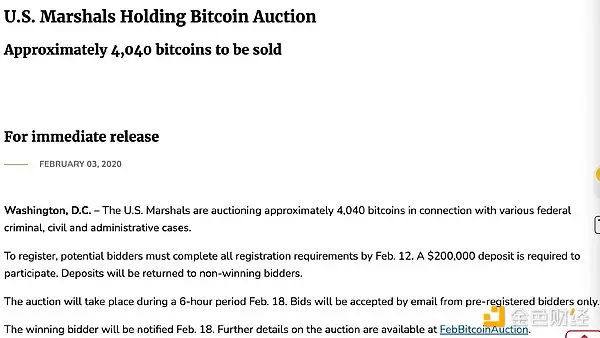
According to the specific sales terms published by the U.S. Marshals at that time, the winning bidder was required to wire the purchase funds to USMS by February 19, 2020, and USMS would not transfer any Bitcoin until it confirmed receipt of the buyer's funds.
This means that from the announcement to the actual auction, and then to the winning bidder receiving the Bitcoin, it could take more than half a month before they could sell it on the market.
Currently, there are only 11 days left until Trump takes office, and Jinse Finance reporters did not find any recent news about the auction of confiscated Bitcoin on the U.S. Marshals' official website.
It is evident that at least before Trump takes office, the U.S. Department of Justice will not actually sell the confiscated Silk Road Bitcoins.
In conclusion, the widely circulated news this morning, which affected the market, "The U.S. Department of Justice has approved the sale of $6.5 billion worth of Bitcoin seized from the Silk Road on the dark web," is likely to be false.
Disclaimer: The content of this article solely reflects the author's opinion and does not represent the platform in any capacity. This article is not intended to serve as a reference for making investment decisions.
You may also like
New York Federal Reserve President: Overall price increases remain too high, inflation may not reach the Fed's target level until 2028
John Williams, President of the New York Federal Reserve, stated on Monday that although some inflationary pressures in the United States have shown signs of easing, the overall rise in prices remains too high.
No more mandatory retention! Anthropic launches EFS system, allowing enterprises to take control of their own AI data
Anthropic has launched the public beta of its Enterprise Frontier Security (EFS) system, allowing corporate clients to store AI data on their own cloud platforms, with clients holding their encryption keys. Anthropic only performs automated security scans and cannot access the data itself. The system retains the 30-day data retention requirement, but control over storage is returned to enterprises, addressing strong customer backlash sparked by the mandatory retention policy implemented in June.

Report: Samsung's storage capacity is nearly sold out for the next three years, clients rush to secure long-term contracts until 2031
According to media reports, most of Samsung Electronics' memory manufacturing capacity for the period from 2027 to 2029 has already been secured through contracts. Some customers are even seeking to extend long-term supply agreements until 2031. Currently, leading memory manufacturers can only meet about 60% to 70% of client demand, and the supply shortage may intensify further in 2027.

Anthropic commits to about $900 billion in computing power expenditure; bond market expects its bonds to be junk-rated
Despite Anthropic raising over $100 billion in its public offering and reaching a market capitalization of $1.18 trillion, the company is widely expected by the debt market to be rated as BB-level "junk bonds" due to its lack of profitability and approximately $900 billion in massive computing power expenditure commitments. Amid pressure on tech giants in the debt market and chip companies planning to reduce loan guarantees, Anthropic will still need to rely on structured financing in the short term, facing about a three-year window to strive for an investment-grade rating.
Crypto prices
More


