Last updated:
December 30, 2025 03:38 EST

 Bitcoin Price Analysis
Donald Trump’s potential Bitcoin stance hinges on the strength of the U.S. economy and the dollar’s dominance in global markets, according to CryptoQuant CEO Ki Young Ju. Bitcoin and gold tend to gain during periods of declining investor confidence in the U.S. economy. However, Trump’s policies may prioritize preserving the dollar as a global safe haven over Bitcoin adoption.
Some nations, like South Korea, still prefer the dollar amidst economic uncertainty, reinforcing its dominance. While this could slow Bitcoin’s institutional adoption under Trump, a weakening U.S. economy might position Bitcoin as a stronger store of value in the long term.
Italy has approved its 2025 budget, targeting a deficit reduction from 3.8% to 3.3% of GDP while offering tax breaks for lower-income groups. However, national debt is expected to rise to 137.8% of GDP, driven by energy subsidies.
Stagnant economic growth, projected at just 0.5% for this year, adds to fiscal challenges. With the EU pressuring Italy to meet a sub-3% deficit by 2026, the country faces economic headwinds.
Bitcoin could emerge as a hedge against fiat volatility for Italian investors, providing an alternative as fiscal pressures mount.
Michael Saylor’s MicroStrategy remains a key Bitcoin supporter, recently acquiring 5,200 BTC at an average price of $106,000 per coin. The company’s holdings now total 444,262 BTC, worth over $41 billion.
Under its 21/21 plan, MicroStrategy aims to raise $42 billion to purchase additional Bitcoin over three years. Saylor’s recent Bitcoin chart post has sparked market optimism, reinforcing institutional confidence in Bitcoin.
These consistent investments suggest that institutional demand could drive Bitcoin prices higher in the coming months.
Bitcoin (BTC/USD) is trading at $93,640, down 1.41% over 24 hours, with bearish momentum dominating short-term trends.
Key support levels are at $92,100 and $90,400, while resistance is observed at $95,800 and $98,300.
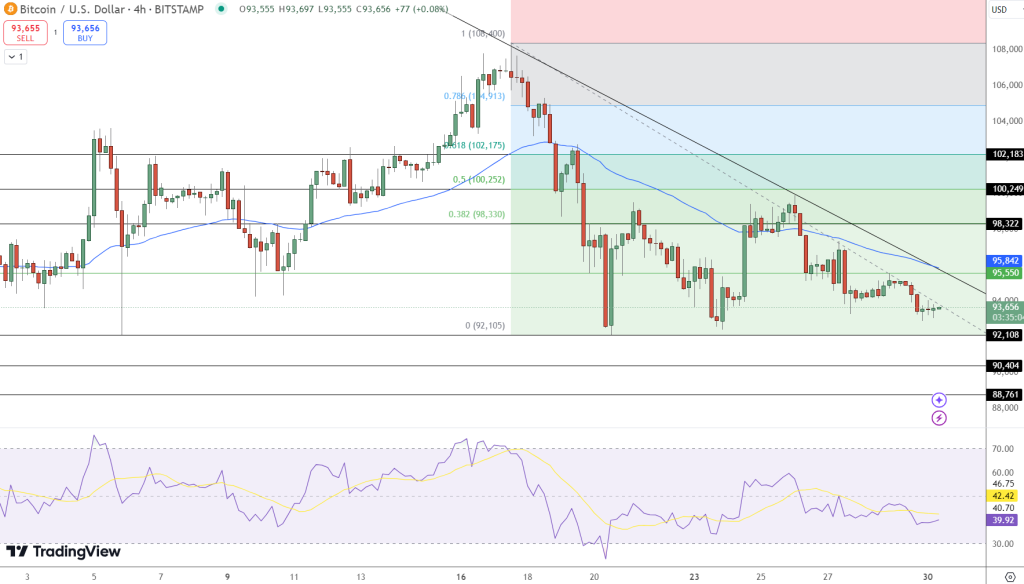
The 4-hour chart reveals a downward trendline and oversold RSI at 40, reflecting selling pressure. A double-bottom pattern near $92,000 provides hope for stabilization.
Bitcoin must break above $95,800 to target $98,300 and regain bullish momentum.
While Bitcoin’s price has remained relatively stable, there’s an emerging opportunity that has captured the attention of investors.
Best Wallet is a revolutionary Web3 platform supporting thousands of cryptocurrencies across 50+ major blockchains, including Bitcoin and Ethereum.
Users can securely manage their assets to buy, sell, and swap both same-chain and cross-chain without requiring KYC verification.
The $BEST token presale has now raised an impressive $5.9 million, priced at $0.023375.
Early investors gain access to exclusive rewards and upcoming project launches.
Why Consider Investing in $BEST?
The project’s active engagement on Twitter and Telegram reflects the strong interest from its community. With robust features and an ever-growing ecosystem, $BEST Wallet continues to distinguish itself as a leader in the Web3 landscape.
Disclaimer: Crypto is a high-risk asset class. This article is provided for informational purposes and does not constitute investment advice. You could lose all of your capital.Disclaimer: The content of this article solely reflects the author's opinion and does not represent the platform in any capacity. This article is not intended to serve as a reference for making investment decisions.
The Federal Reserve develops contingency plans for three types of AI impact: productivity boom, mass unemployment, and bubble burst.
Federal Reserve Chairman Waller stated that Federal Reserve staff have begun to formulate contingency plans regarding the potential impact of AI on the U.S. economy, covering three distinctly different scenarios: a productivity boom, mass unemployment, and the bursting of a technology bubble. Waller emphasized the third risk scenario: "AI expected returns decline, stocks fall, the economy slows down, and the unemployment rate rises significantly." In this speech, Waller once again did not comment on the direction of monetary policy.

Strive buys 251 BTC for $17.5 million, average price drops to $69,853
Nvidia enhances scientific computing! Launches Rubin HPC GPU, betting on AI agents to reshape supercomputing
Rubin HPC features a single GPU equipped with over 50,000 CUDA cores, optimized for scientific computing, and is expected to launch in 2028. CUDA-X expands its scientific computing footprint, covering fields such as astrophysics, materials science, drug development, and single-cell biology, reducing black hole analysis from one month to just eight minutes. Nvidia showcased the integration of photonic interconnect and quantum computing, enhancing supercomputing infrastructure, stating that Lambda uses Nvidia’s photonic co-packaged optical technology (CPO) to achieve up to 5 times higher energy efficiency. Nvidia is also extending the Slurm workload management system to incorporate quantum processors (QPU) into traditional supercomputing workflows. Additionally, Nvidia announced that Vera CPU racks will be available early next year, with Dell, HPE, Lenovo, and Supermicro as suppliers.

Bernstein: OpenAI launches ChatGPT wallet, AI payment competition enters a new turning point, Visa (V.US) and Mastercard (MA.US) expected to become big winners
As AI agents evolve from information query tools to personal assistants capable of independently completing shopping and payment tasks, the global payments industry is facing new competitive opportunities.