
Polymarket performs smoothly on Election Day, processes $240M in trading volumes

Polymarket’s underlying blockchain chugged along more or less smoothly, processing 2,921,668 transactions on election day
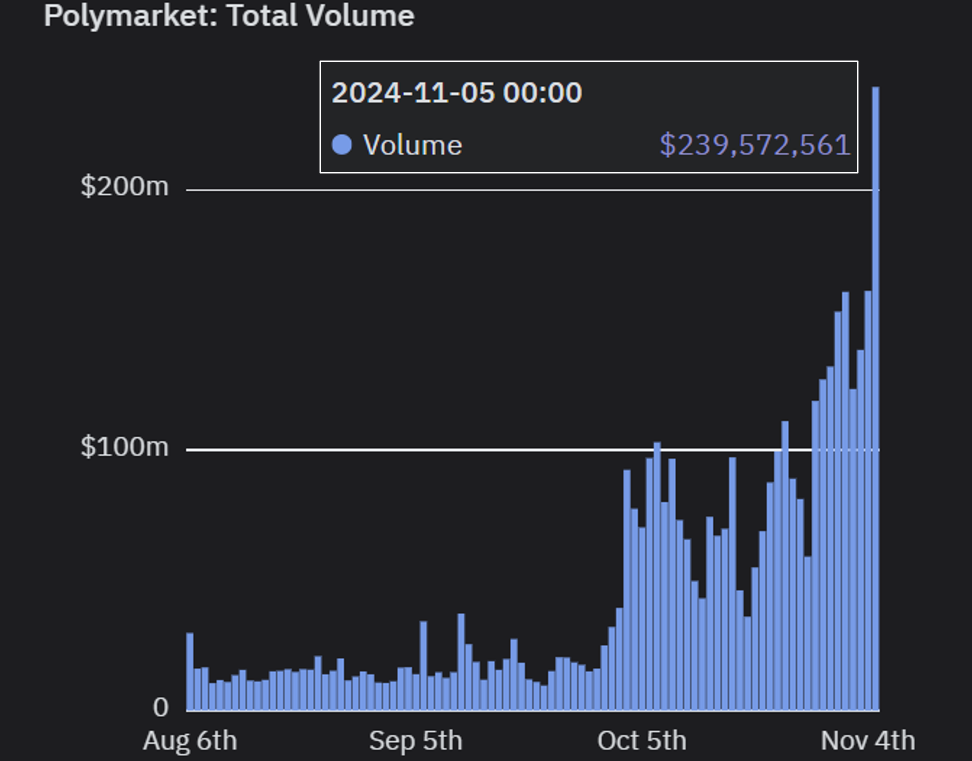
On the most important night of the year for Polymarket, crypto’s breakout star application processed a smooth $240 million in trading volumes without a hitch.
 Source: Blockworks Research
It’s an impressive feat for a dapp that is mostly onchain, representing perhaps one of crypto’s first “mainstream” tests.
Polymarket is designed as a “binary limit order book” ( BLOB ), a kind of hybrid-decentralized model that is common in many DEXs. Matching (i.e. placing limit orders) on Polymarket is offchain, while settlement and execution of trades goes onchain on Polygon’s PoS sidechain.
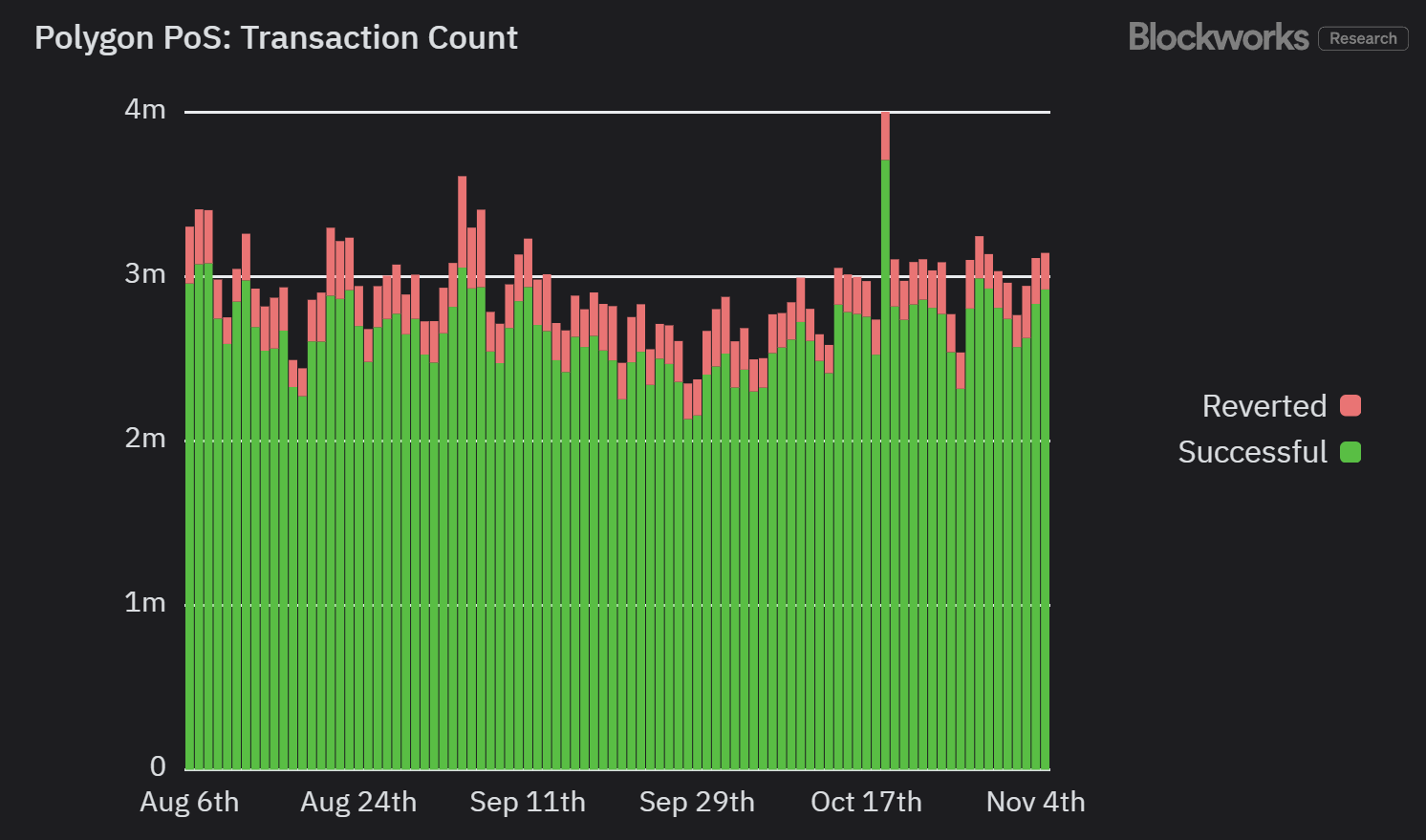
The underlying blockchain chugged along more or less smoothly, processing 2,921,668 transactions on election day, or about 33.8 TPS at a 7% reversion rate, Blockworks Research data shows.
 Source: Blockworks Research
Newsletter
Subscribe to Blockworks Daily
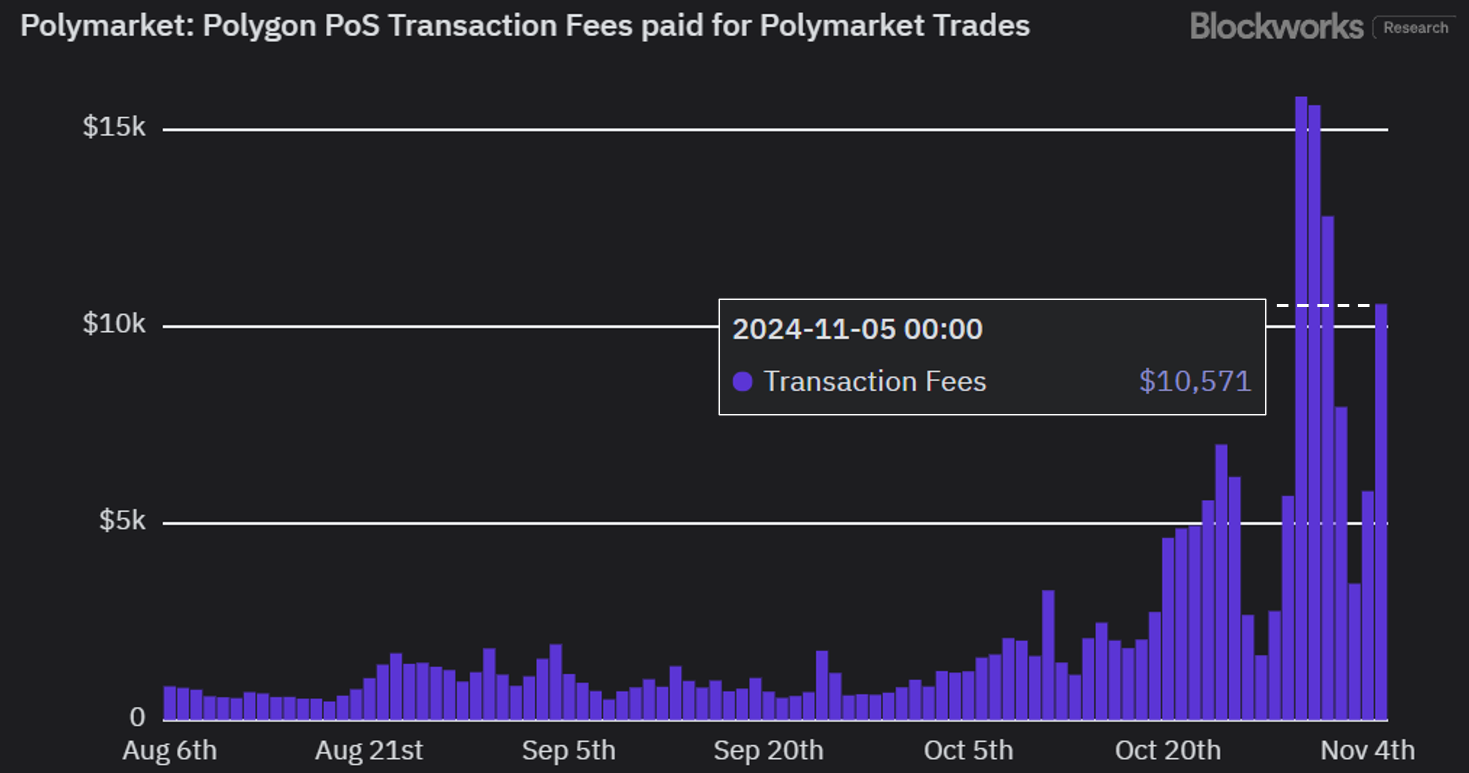
Polygon is taking many well-deserved victory laps , but what’s not talked about is how little value has accrued to its POL token despite Polymarket’s success. On election day alone, Polymarket users generated a pretty minor $10,571 in fees for Polygon.
The price of POL ( previously MATIC ) is up 7.2% on the day at $0.3, but still down about 54% year to date.
 Source: Blockworks Research
This is not a knock on Polygon; Polygon’s sidechain design was aimed at delivering ultra-low fees at a time when L2s were still relatively scarce.
Polygon’s bet on POL’s value accrual is aimed at the token’s utility in staking for various different Polygon-related services like block batching in the Agglayer, or providing data availability within its Staking Hub/Layer in 2025.
The plan is also to let POL stakers derive fee revenue from other Polygon CDK chains within its aggregated network of blockchains.
But back to Polymarket — where does the prediction market go from here?
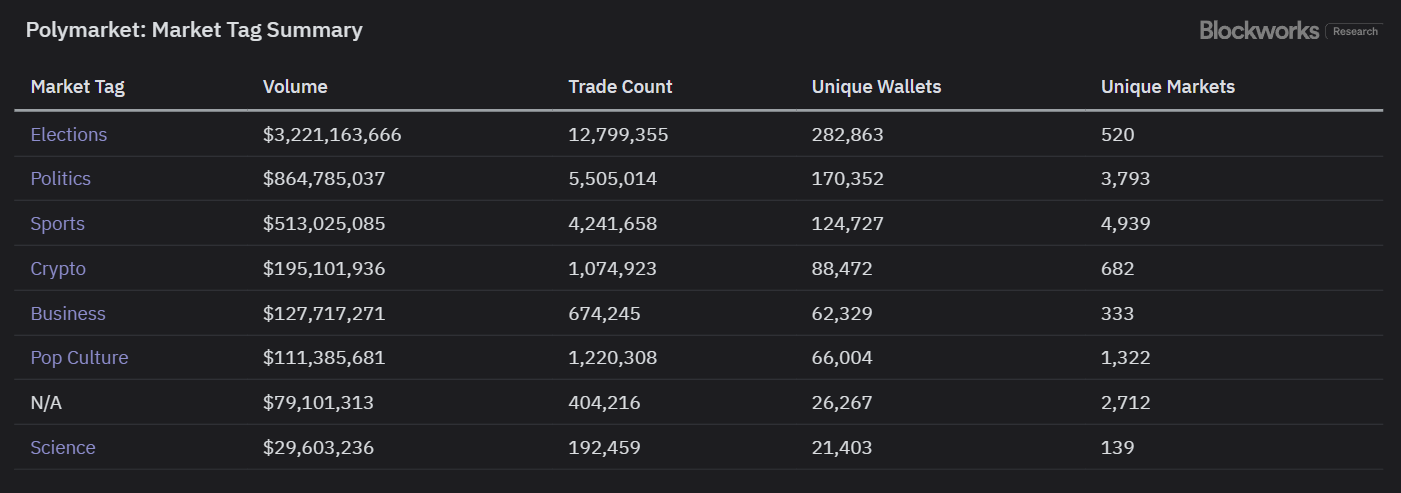
The majority of Polymarket’s usage comes from US political elections. Post-election, Polymarket’s continued success will have to rely on other areas of interest that can stoke the same kind of mainstream appetite as political gambling.
 Source: Blockworks Research
Sports, which makes up the third-largest category of open interest on Polymarket, is one possible demand driver, but that area of gambling is also saturated with existing crypto players like Shuffle, Gandom, Rollbit, Stake.com and more, as well as a slew of Web2 offerings.
For more on Polymarket’s next steps, plug into the latest 0xResearch podcast .
Start your day with top crypto insights from David Canellis and Katherine Ross. Subscribe to the Empire newsletter .
Explore the growing intersection between crypto, macroeconomics, policy and finance with Ben Strack, Casey Wagner and Felix Jauvin. Subscribe to the Forward Guidance newsletter .
Get alpha directly in your inbox with the 0xResearch newsletter — market highlights, charts, degen trade ideas, governance updates, and more.
The Lightspeed newsletter is all things Solana, in your inbox, every day. Subscribe to daily Solana news from Jack Kubinec and Jeff Albus.
- Polygon
- Polymarket
- US politics
Disclaimer: The content of this article solely reflects the author's opinion and does not represent the platform in any capacity. This article is not intended to serve as a reference for making investment decisions.
You may also like
One month before the IPOs of Anthropic and SpaceX, bitcoin fell 22%. How will liquidity dynamics drive the future market trend?
SBET's Chief Investment Officer attributes this phenomenon to a "liquidity event rapidly increasing correlations between assets"—investors sell crypto assets to participate in star IPOs. Following this logic, most brokerages require investors to wait 15 to 30 days after being allotted new shares before selling. After the SpaceX IPO, on the 31st day, ETH’s price surpassed its level on the IPO day, and by the 70th day, BTC's downward trend reversed.

WeRide Q3 revenue increased by 88% year-on-year, AI infrastructure revenue nearly doubled, Robotaxi single-quarter revenue surpassed 100 million yuan for the first time | Earnings Report Insights
WeRide's revenue for the third quarter reached 320 million yuan, surpassing the market expectation of 270 million yuan. Its net loss was 310 million yuan, lower than the expected 400 million yuan. Overseas income grew by 171.5% year-on-year, driving the gross margin up to 43%. The Guangzhou Robotaxi business achieved positive unit economics for the first time. However, increased R&D investment led to a larger adjusted loss, indicating profitability still needs improvement.
Wall Street technology veteran Niles is optimistic that Anthropic (ANT.US) will win the AI agent price war, but warns that its stock price may fall below the offering price.
Anthropic's IPO exceeded expectations, but Dan Niles warns of valuation risks, slowing growth in AI revenue, and price competition.
After Jensen Huang's resignation, Nvidia faces a new threat: losing its top engineers
Thousands of Nvidia employees have petitioned for Jensen Huang to return to his position, with some publicly criticizing the board's decision; some employees have already announced their resignation. Interim CEO Kress has issued early salary increases and stock rewards in an effort to stabilize the team, but AMD, Broadcom, and AI startups are poised to poach talent. Analysts warn that if five to ten key technology leaders leave, it could affect decisions on chip and software architecture, product iteration, and the planning of next-generation AI technologies.

Crypto prices
More


