
Grayscale Bitcoin Mini Trust records $191 million inflows after soft debut
Key Takeaways
- Grayscale's Bitcoin Mini Trust continued its strong performance on Thursday, attracting an additional $191 million in inflows.
- The Grayscale Bitcoin ETF has suffered over $19 billion in losses post-ETF conversion.
Grayscale’s Bitcoin Mini Trust got off to a strong start after pulling in $191 million on Thursday, its second day of trading, data from Farside Investors shows. The surge marks a 960% uptick from its initial day’s $18 million.
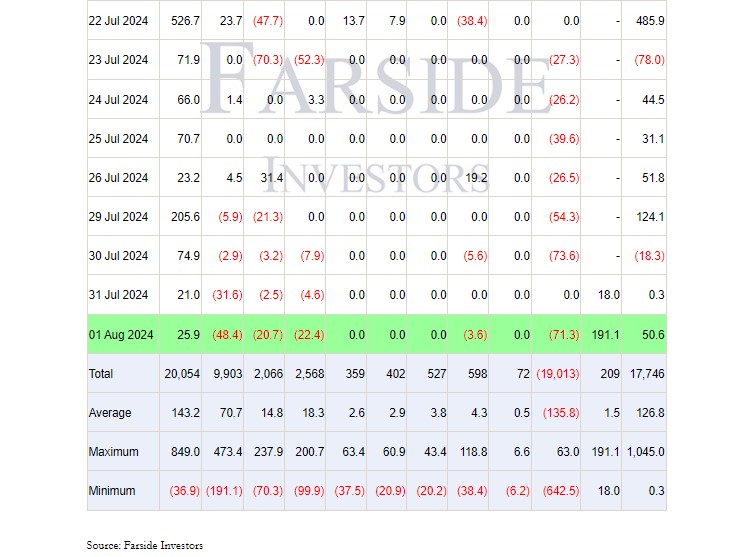 US spot
Bitcoin ETF flows on August 1 – Source: Farside Investors
The fund, operating under the BTC ticker, comes as part of Grayscale Investments’ ongoing efforts to attract investors with a low-cost option for gaining exposure to Bitcoin. With a 0.15% sponsor fee, Grayscale’s BTC is the cheapest spot Bitcoin exchange-traded fund (ETF) on the market.
The mini fund is also expected to alleviate selling pressure on the Grayscale Bitcoin Trust (GBTC) and capture a portion of GBTC’s capital outflows.
Thursday’s gain brings the total net inflows of the BTC to $209 million. According to updated data from Grayscale, its market value stands at around $1.7 billion.
In contrast, GBTC reported approximately $71 million in net outflows on Thursday. The fund’s total loss after its ETF conversion exceeded $19 billion.
Other competing ETFs, including Fidelity’s FBTC, Bitwise’s BITB, ARK Invest/21Shares’ ARKB, and VanEck’s HODL, also witnessed capital withdrawals.
BlackRock’s Bitcoin ETF (IBIT) ended the day with almost $26 million in net inflows. Overall, US spot Bitcoin ETFs collectively took in over $50 million.
Disclaimer: The content of this article solely reflects the author's opinion and does not represent the platform in any capacity. This article is not intended to serve as a reference for making investment decisions.
You may also like
Bank of America Hartnett: Strong US dollar impacts global liquidity, risk assets remain difficult to enter, turning point postponed to next spring
Bank of America's chief strategist Hartnett maintains a risk-averse stance, pushing the entry window back to next spring. The US Dollar Index has hit a new yearly high, and combined with high oil prices and persistent inflation, none of his three entry conditions have been met. He now expects the US dollar to peak between February and March next year, with the end of the global rate hike cycle delayed until the Federal Reserve's meeting in April. Currently, risk assets are "too expensive to go long, but also difficult to short due to protective measures."

US Stock IPO Analysis | Juneng Technology (NENG.US): The "Middleman" in the Short Video Advertising Boom, How Long Can the Long-Tail Traffic Dividend Last?
After the fundraising scale was increased, the valuation of JN Tech grew by about 13%.

Nvidia reduces customer collateral size

Strategy Is Officially Out of MSCI: What It Could Mean for MSTR and Bitcoin

Crypto prices
More


