
Opinion: L2 is the savior of users, but the predator of L1
Original article by: Decentralised.Co
Original translation: TechFlow
Is L2 plundering the interests of L1?
L2 uses L1 for settlement while providing cheaper transaction services to users. They act as intermediaries between L1 and users and capture part of the value by charging fees (including MEV). So, are they paying enough for using L1s valuable block space? Lets analyze the impact of L2 on Ethereum through four charts.
1. How does L2 help the Ethereum ecosystem?
Without talking about L2 tokens, let’s look at their contribution to the entire Ethereum ecosystem. One way to measure this is to look at the increase in ETH market value from L2 tokens.
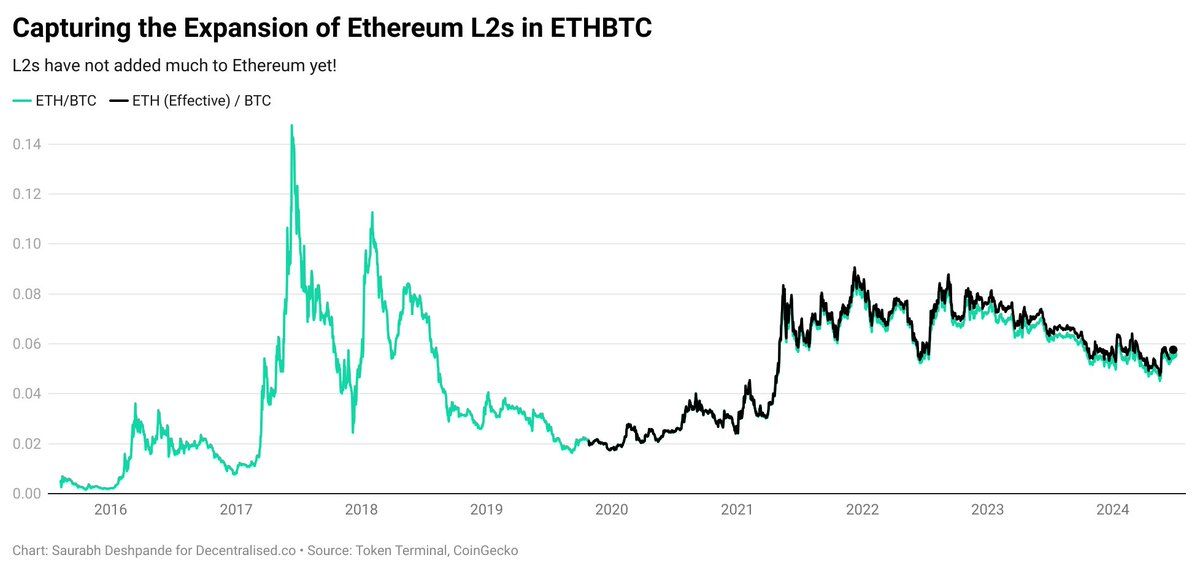
For comparison, I use the ETHBTC ratio as a benchmark of how the Ethereum ecosystem is trending relative to Bitcoin.
To capture the value of Ethereum as a whole, I added the top 10 L2 tokens by market cap to ETH and considered that as “effective ETH” or the value of the entire Ethereum ecosystem.
Currently, the top 10 L2s have little impact on the ETHBTC ratio. As Bitcoin’s market dominance exceeds 50%, the chart below shows that L2s have not significantly increased the ETH(effective)/BTC ratio (see black line vs. green line).
2. So, where does value capture happen?
In simple terms, value capture can be measured by two metrics: revenue and market capitalization. If value is generated, it will be reflected in the price.
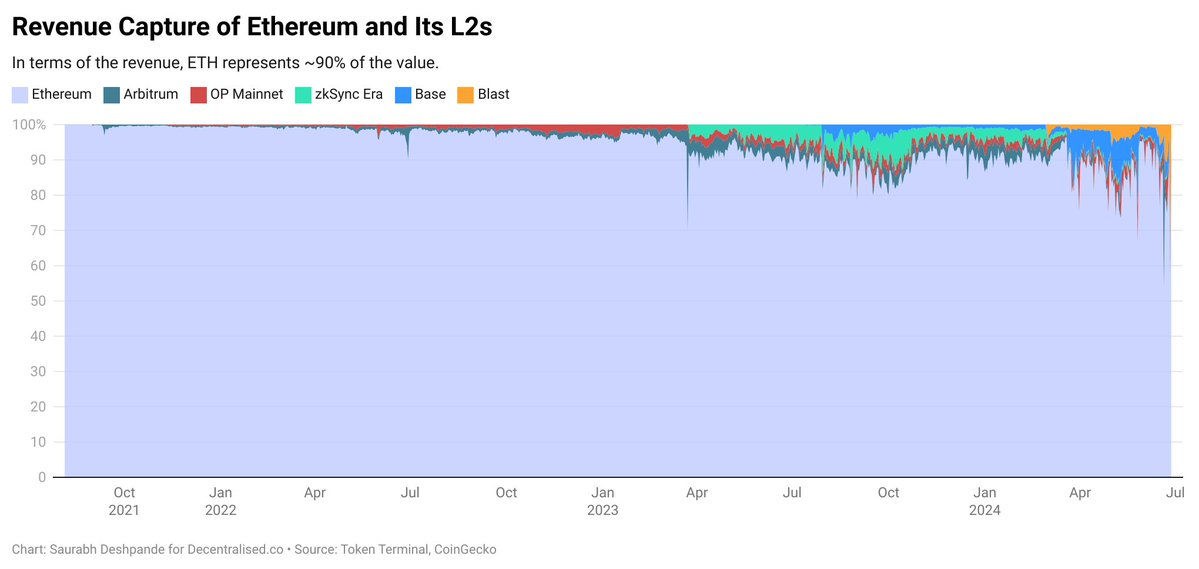
a. Where is revenue captured? Ethereum regularly captures ~90% of the total Ethereum ecosystem revenue. In Q2 2024, Base has been the leading L2 by revenue, followed by Blast.
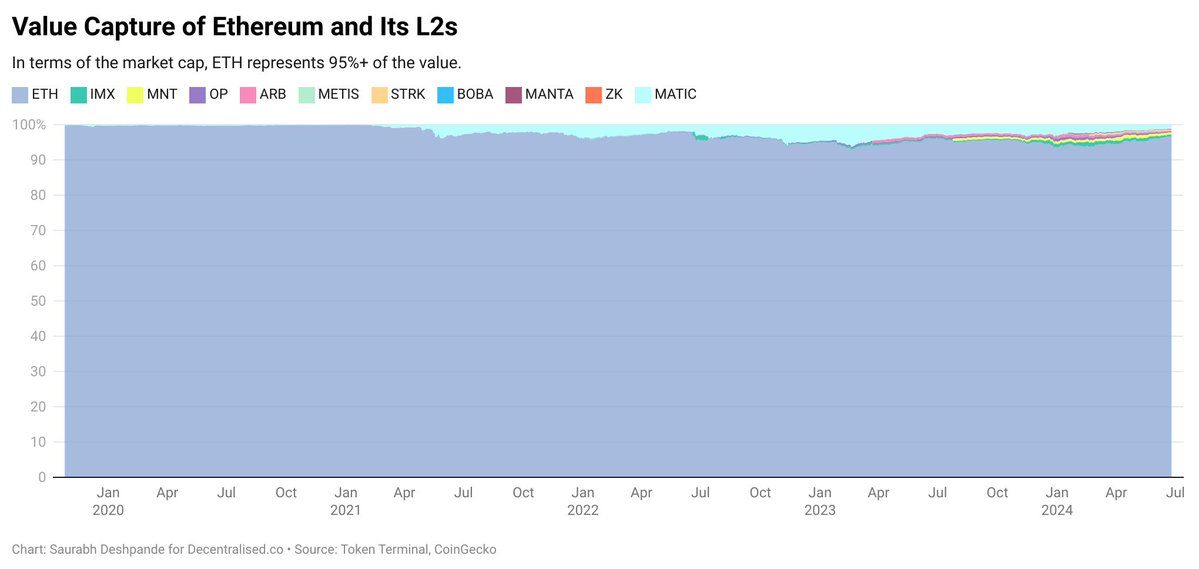
b. In terms of market capitalization, ETH still accounts for more than 95% of the top 10 L2 market capitalization.
3.How much revenue does L2 pass to Ethereum?
L2 incurs costs for storing data on Ethereum. This is the operating cost of L2. This cost needs to be balanced. If the cost is too high, L2 operations will become difficu< if the cost is too low, although Ethereum provides key settlement services, it will not earn much revenue from L2.
Ethereum’s 4844 upgrade (also known as Proto Danksharding) reduces the operating costs of L2. The reduction in the cost of L2 data storage has reduced L2’s contribution to Ethereum’s revenue from about 10% to about 2%. While this may seem like a setback, it makes L2 ready for more users because transaction costs are reduced.
So far, blobs seem like a bad idea from Ethereum’s perspective. So what’s the end goal? Scaling.

In one week in 2024, Ethereum supported 7.1 million transactions with $10.6 million in revenue. The cost per transaction for users was about $1.5. Meanwhile, five L2s (Arbitrum, Base, Blast, Optimism, and Polygon) supported over 70 million transactions with $2.75 million in fees. The cost per transaction was just $0.03.
We can discuss the quality of transactions, whether they are bots or their value, etc. But the fact is that Ethereum cannot support that many transactions.
In general, by building L2 and lowering transaction costs on L2 by providing them with cheaper data storage options on L1, this is good for users, but not so good for Ethereum (L1). If most users choose to transact on L2, more data will be pushed to L1. As L2 pushes more data and competes with each other for L1s block space, L1s base fee will increase, thereby increasing Ethereums revenue. Therefore, when more people start using L2, it can be a win-win for Ethereum and users.
Disclaimer: The content of this article solely reflects the author's opinion and does not represent the platform in any capacity. This article is not intended to serve as a reference for making investment decisions.
You may also like
Anthropic (ANT.US) rises 17% on its first day of listing, but volatility risk remains! Wall Street warns: Don't rush to chase highs, stock price may experience severe fluctuations in the coming weeks
Anthropic (ANT.US)'s unprecedented initial public offering (IPO) on Thursday injected much-needed momentum into the US stock market, which had experienced several weeks of weakness. However, analysts warn that the stock price may continue to fluctuate in the coming weeks.

SpaceX (SPCX.US) Raises More Funds for AI Chips: Issues $32 Billion Bonds to Purchase Nvidia GPUs
SpaceX sold artificial intelligence chip bonds worth $32 billion, with a yield exceeding 8%.
Falling below 3600, gold is set for its worst week since March
Spot gold hit an intraday low of $3,520, having pulled back by more than one-third from its all-time high. The combined pressures of hawkish signals from the Federal Reserve, sell-offs in tech stocks, and a stronger US dollar have pushed the 10-year US Treasury yield above 5% for 29 consecutive days. From a technical perspective, there is almost no support before the $3,300 to $3,400 range. Standard Chartered attributes the current decline to a shift in gold's role—from a “portfolio safe-haven asset” to a “liquidity provider.”
First 24-hour sales may reach quarterly forecasts! GTA 6 amazes Morgan Stanley
GTA 6 achieved $1.8 billion in first-day sales with approximately 19 million copies sold, breaking the record for the strongest game launch in history. The game received a score of 99 on Metacritic, surpassing The Legend of Zelda: Ocarina of Time’s 28-year record. Morgan Stanley indicated that, at the current pace, GTA 6 is likely to reach the 30 million sales target within 24 hours and maintains its Overweight rating on Take-Two.
Crypto prices
More


