
Auto-Deleveraging at Bitget: A Deep Dive
Perpetual futures let you hold a leveraged position with no expiry date. This amplifies your profit as well as your loss. And when the loss exceeds your available margin, a liquidation will be triggered.
Liquidation is a crucial process in perpetual futures trading and every exchange needs a comprehensive plan for it. This is because during extreme price fluctuations, a liquidated position may not be closed at a price that covers its losses. Bitget's Insurance Fund and Auto-deleveraging (ADL) are designed for situations such as these.
This guide covers when and how a position triggers an ADL, how ADL works, how often ADLs have happened, and how we have reduced the likelihood of ADLs in general. It also sets out the position controls an institutional desk can run to stay far from the front of the ADL queue. The figures come from our internal ADL records from 1 April 2025 to 30 October 2026, and from Insurance Fund balances as of 7 November 2026, 21:00 (UTC+8).
The Layers That Come Before ADL
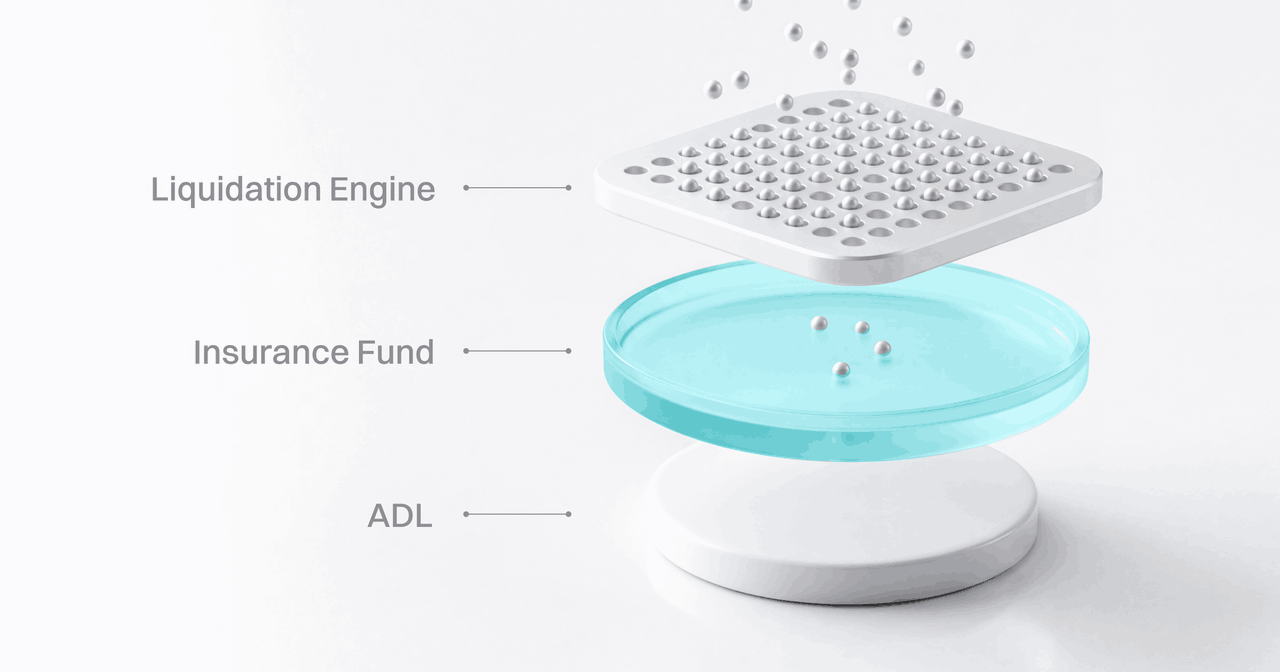
When a leveraged position reaches its liquidation threshold - its maintenance margin ratio (MMR) exceeds 100% - 3 things can happen in this order:
-
The liquidation engine takes over and closes the position by matching it with outstanding orders.
-
If the position's losses exceed its margin, the result is a bankruptcy loss, and the Insurance Fund absorbs that shortfall.
-
If the Insurance Fund cannot cover the loss, an ADL will be triggered.
Bitget's Insurance Fund is funded ahead of time and consists of a number of insurance pools. When the balance falls, we may inject additional funds to keep the reserve at an adequate level. An ADL is only triggered when even the corresponding insurance pool can not absorb the loss.
When ADL Can Trigger
Trigger conditions for ADL are assessed independently for each contract. The condition depends on which type of insurance pool backs the contract.
| Insurance pool type |
Applicable scope |
ADL trigger |
Data refresh |
| Standalone |
Coin-margined contracts, USDC-margined contracts, and USDT-margined BTC, ETH, and SOL contracts |
Pool equity falls to 0 or below |
1 minute |
| Aggregated |
Other USDT-margined contracts than BTC, ETH, and SOL |
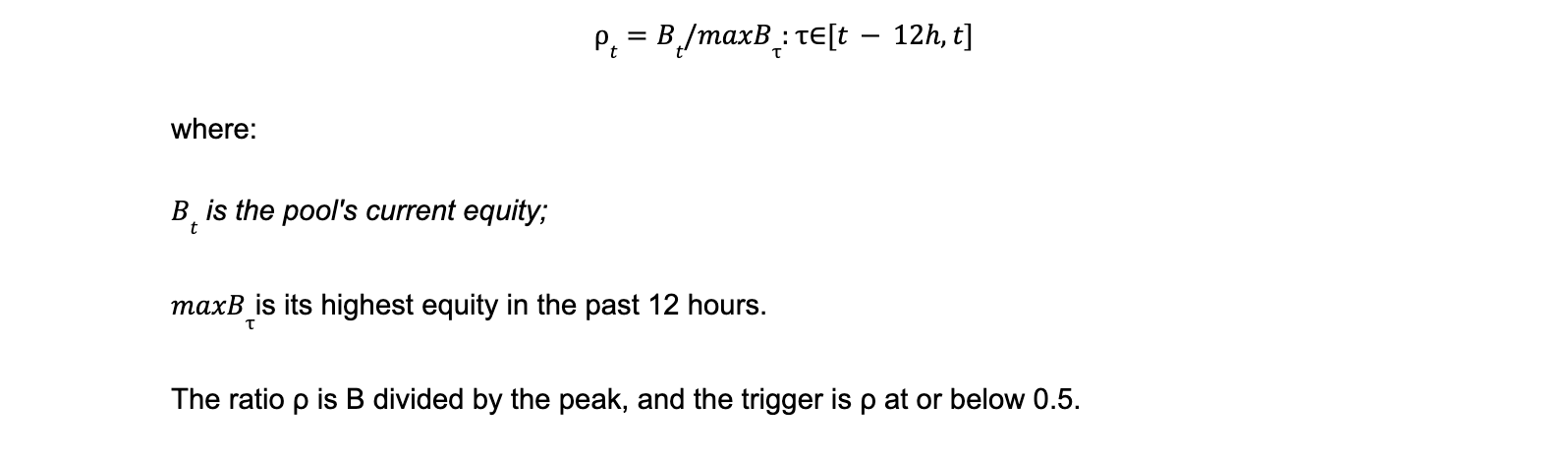
Pool equity falls to 50% of its peak balance over the last 12 hours |
1 hour |
A standalone pool only fails when its equity falls to 0 or below. For an aggregated pool, the check is a ratio:
Here is a worked example with illustrative figures:
An aggregated pool reaches a peak of 10.00 million USDT within the last 12 hours. Its trigger level is therefore 5.00 million USDT. If equity falls to 6.50 million USDT, ρ is 0.65: the pool has lost 35% from its peak and ADL will not trigger. If equity falls to 5.00 million USDT, ρ is 0.50 and the trigger condition is met. The pool balance, the peak and the ratio can all be read from public data here.
Once ADL is triggered, we match the affected position directly with the highest-ranked eligible counterparty positions on the ADL list. These executions carry no trading fees and are generally filled at the mark price.
Create a Bitget account and complete identity verification to see which futures markets are available in your region.
How ADL Works
If ADL triggers, we do not pick counterparties at random. The system selects positions with highest ADL scores, and 2 inputs raise that score: higher unrealized profit and higher leverage. A position with both sits closer to the front of the queue. Note that even losing positions can get high ADL scores.
A winning position's ADL score is calculated as its return-on-investment (ROI) ratio times the account's MMR, while a losing position's ADL score is calculated as its ROI ratio divided by the account's MMR. Since ROI drives the score and your account's MMR is a predefined number, you can calculate your own ADL score and lower your rank by reducing your ROI ratio, which we cover later in this article.
Say a long position of 5,000 USDT triggers an ADL and is looking for counterparties. Our liquidation engine will take over the highest-scored short position first and try to close both positions at the current mark price immediately with no fee charged.
If the counterparty has a larger position size, say, 10,000 USDT, then only half (5,000 USDT) will be closed and a portion of its unrealized profit will be realized. If the counterparty is not large enough to fully match the liquidated position, our engine will move onto the next highest-scored position and try to match them until the liquidated position is fully closed.
You can open a Bitget account to create read-only API keys and watch adlRank for your own positions.
How Often ADL Has Happened
While ADL may seem complicated and extreme, it has been uncommon. Our sample covers records from 1 April 2025 to 30 October 2026 in which an individual contract's daily ADL notional reached at least 50,000 USDT. That gives 109 records across 97 contracts. ADL occurred on 41 of the 578 calendar days in that window.
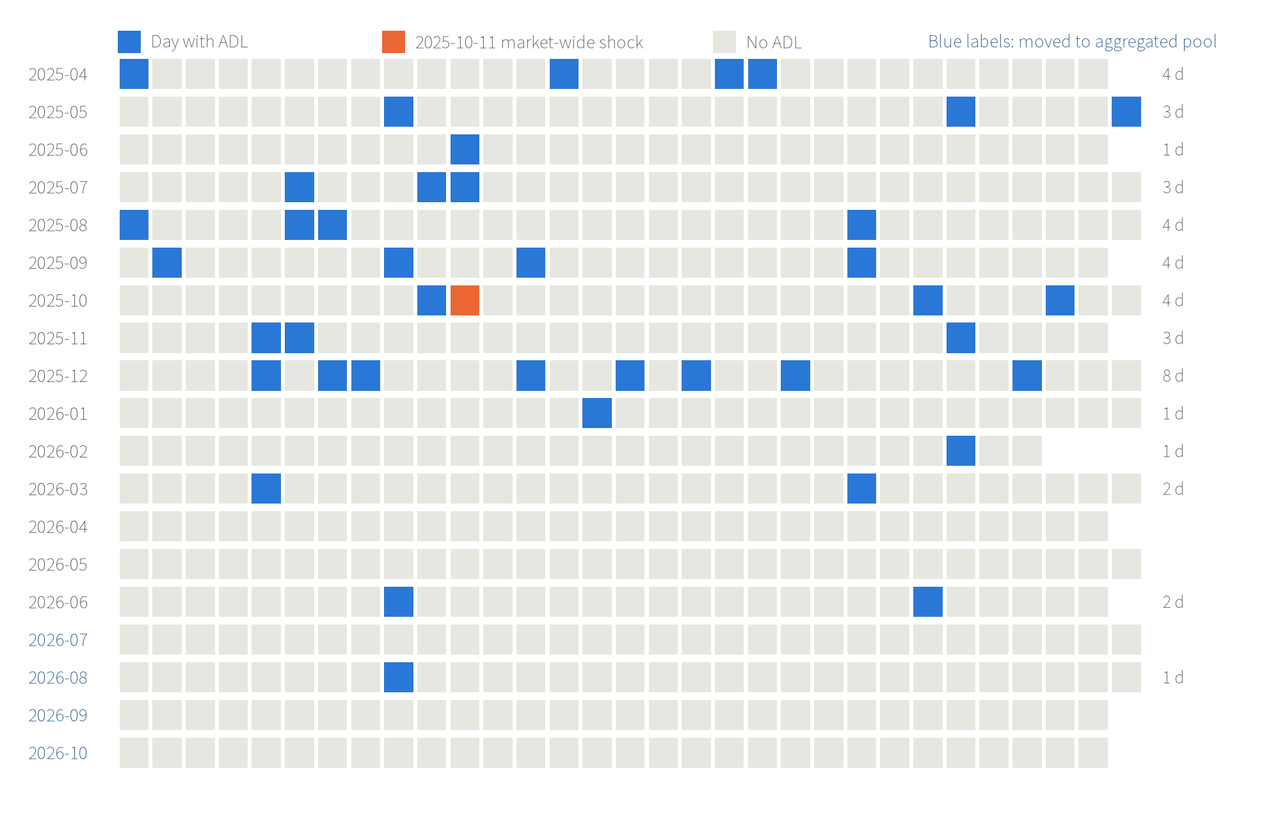
The split around the July 2026 change is the clearest signal:
| Period |
Days |
Days with ADL |
Share of days |
| 1 April 2025 to 30 June 2026 |
456 |
40 |
8.80% |
| 1 July to 30 October 2026 |
122 |
1 |
0.80% |
From 1 July to 30 October 2026, ADL occurred on 1 of 122 days (0.8%). In the 456 days before most USDT-margined contracts moved to aggregated insurance pools in July 2026, it occurred on 40 days (8.8%). No TradFi contract has triggered ADL since TradFi contracts were listed. The one record after the move came on 9 August 2026, in a single contract whose intraday range reached 1,311%. April and May 2026 had no ADL days at all.
Why Aggregated Insurance Pools Make ADL Rarer
This drop in ADL frequency did not happen by accident. In July 2026, we made a conscious decision of moving most USDT-margined contracts from individual insurance pools to aggregated pools. Several contracts now share one pool, so the whole pool absorbs bankruptcy loss in a single contract. Each aggregated pool holds at least USDT 2.51 million. The 50% drawdown condition adds a second fence: the pool's equity must fall to half of its 12-hour peak before ADL triggers.
As of 7 November 2026, 21:00 (UTC+8), the combined balance of all aggregated and standalone insurance pools was approximately US$334.7 million.
| Category |
Number of pools |
Approximate USD value |
| USDT-margined, aggregated pools |
41 |
US$170.5 million |
| USDT-margined, standalone pools (BTC, ETH, SOL) |
3 |
US$156.6 million |
| USDC-margined, standalone pools |
50 |
US$1.51 million |
| Coin-margined, standalone pools |
21 |
US$6.09 million |
| Total |
115 |
US$334.7 million |
Aggregated pool balances range from 2.51 million USDT at the minimum to 14.98 million at the maximum USDT, with a median of USDT 3.16 million. The standalone pools for the largest contracts are larger: approximately USDT 94.56 million for BTC, USDT 46.46 million for ETH and USDT 15.57 million for SOL.
These aggregated pools are now backing your positions with an even larger margin for error and they are exactly the reason why only one ADL event has occurred since the transition.
How Large ADL Events Have Been
Open interest (OI) is the total value of open positions in a market. Comparing ADL notional with same-day peak OI shows how much of a market ADL touched. Among the 66 events with OI data, the median ADL notional was 2.2% of same-day peak OI, and 60 of 66 events (91%) were at or below 10%.
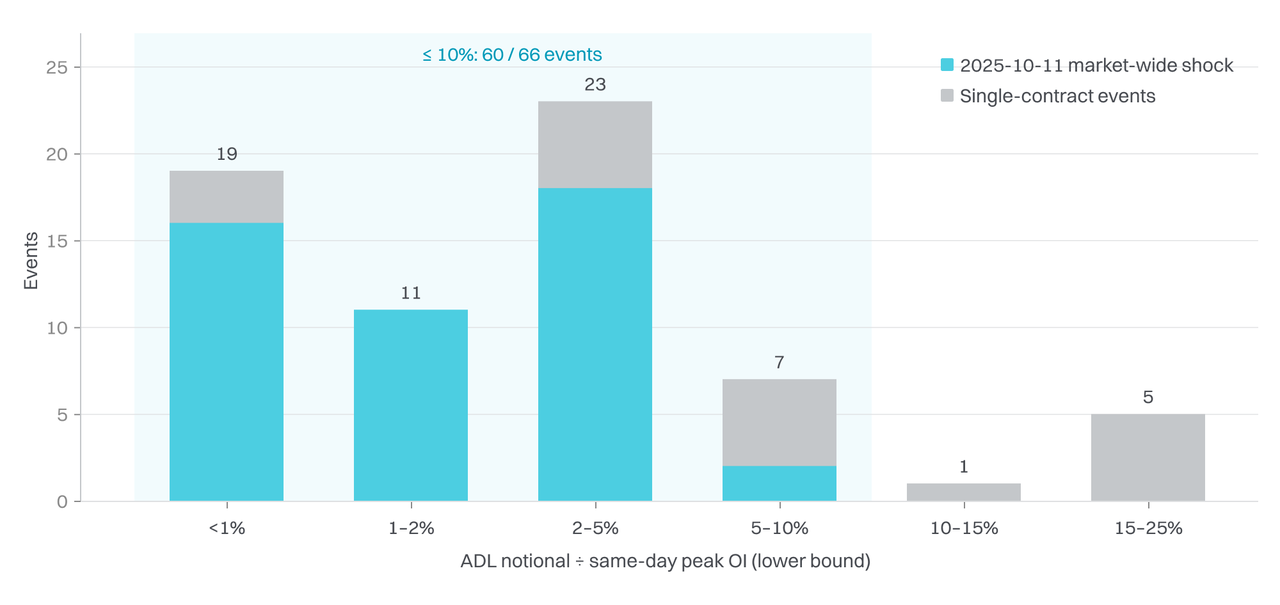
These 66 events fall into 2 groups.
| Measure |
11 October 2025 market-wide shock |
Other single-contract events |
Total |
| Records |
55 |
54 |
109 |
| ADL notional (USDT) |
66.76M |
156.6M |
223M |
| Records with intraday range of 50% or more |
48 of 49 |
23 of 30 |
71 of 79 |
| ADL notional ÷ OI, median |
1.80% |
6.60% |
2.20% |
| ADL notional ÷ OI, 90th percentile |
4.30% |
16.90% |
8.10% |
| ADL notional ÷ OI, maximum |
6.20% |
23.60% |
23.60% |
| Events at or below 10% of OI |
47 of 47 |
13 of 19 |
60 of 66 |
The market-wide shock followed a liquidity shock on 10 October 2025 and led to ADL on 11 October 2025 (UTC+8) across many contracts, including small-cap assets and major assets such as BNB, LINK and AVAX. Prices typically fell sharply and then made a substantial recovery by the close. AVAX, for example, fell to a low 69% below its opening price and closed 16% below the open. Across the 47 events in that shock with OI data, the highest ADL-to-OI ratio was 6.2%. That day predates the aggregated pools.
The single-contract events show the other end of the range. Six events sat above the 10% line, and each was isolated to one contract. The highest ratio was 23.6%.
Where ADL Concentrates
ADL almost only occurs during extreme price moves. Of the 79 records with price data, 71 had an intraday range of at least 50%. The single-contract events were concentrated in newly listed or less liquid contracts, where prices sometimes moved by multiples within a day. Seven of the single-contract events had an intraday range below 50%.
For position management, the pattern is this: ADL has followed violent moves in thin markets, and the events with the highest ADL-to-OI ratios sat in those same contracts. A position sized in proportion to a contract's OI, and held at moderate leverage, sits outside that profile.
What You Can Check Yourself
We publish the inputs to ADL through the API. Two of the endpoints are public and need no account.
| Endpoint |
Access |
What it returns |
| GET /api/v3/position/adlRank |
Private. Needs read-only or read/write trading permission for the Unified Trading Account (UTA). 1 request per second per UID. No request parameters |
For each position: symbol, margin coin, adlRank and hold side (long or short) |
| WebSocket topic adl-notification with instType UTA |
Private |
A real-time push when a position in your account is affected by ADL: symbol and side, status (triggered), execution price, executed quantity in base coin, and a start time in Unix milliseconds |
| GET /api/v3/market/risk-reserve-all |
Public. 3 requests per second per IP |
Current Insurance Fund balances by category (USDT-FUTURES, COIN-FUTURES or USDC-FUTURES). Standalone pool data refreshes every minute and aggregated pool data every hour. An aggregated pool lists several trading pairs and a standalone pool lists one |
| GET /api/v3/market/risk-reserve |
Public. 20 requests per second per IP |
Daily balance records for the past 30 days for the pool behind a given symbol. Category and symbol are required, plus margin coin for coin-margined contracts |
| GET /api/v3/market/risk-reserve-hour |
Public. 20 requests per second per IP |
Hourly balance records for the past 30 hours, with the same parameters as the daily endpoint |
The hourly endpoint is the one to use for the ratio described earlier. Its records are enough to compute the 12-hour peak drawdown ρ for any aggregated pool. For contracts in an aggregated pool, every contract in the pool returns identical records, because they share the balance.
You can try the current balance endpoint with no credentials. Both historical endpoints keep records for a limited period, 30 days for daily and 30 hours for hourly. If you want a longer history, you can retrieve and store the data on a schedule.
Risk Controls for Institutions
ADL is rare, and the controls below make it rarer for your book. This table shows what to watch and what to do. The thresholds for adlRank come from our guidance, and the pool ρ level of 0.7 is an example you can tune to your own risk appetite.
| Situation |
What to watch |
Suggested action |
| Routine monitoring |
Poll adlRank and subscribe to adl-notification |
Keep an adlRank history for each contract. No action is generally needed while adlRank stays below 0.5 |
| Rank rising |
adlRank stays above 0.8 |
Realize profits promptly. Close profitable positions in stages to convert unrealized PnL into realized PnL. You can also add margin to lower the maintenance margin ratio |
| Insurance pool under stress |
Aggregated pool ρ below 0.7 (example), or a standalone pool balance falling quickly |
Consider reducing profitable positions in the affected contract in advance, rather than having them reduced automatically when the trigger is reached |
| Volatile contracts |
Newly listed or small-OI contracts with an intraday range already above 50% |
Keep position size proportionate to the contract's OI, since the events with higher ADL-to-OI ratios were concentrated in these contracts |
| Hedged positions |
Spot and futures held in opposite directions |
Keep the net futures position within 5% of the total position and use Delta Neutral mode to move eligible hedged positions toward the back of the queue |
| Trigger notification received |
adl-notification returns triggered |
Update exposure using the execution price and quantity in the notification, re-hedge the remaining position and review margin requirements |
To simply lower the rank of your existing positions, there are some steps you can take right now:
| Method |
Effect |
| Take leverage through institutional lending |
Lending leverage does not affect the ADL score, so capital efficiency can rise without raising your rank |
| Add margin |
Lowers the account maintenance margin rate |
| Take profit on or reduce profitable positions |
Lowers the ROI and margin usage |
| Hedge to offset unrealized PnL |
Lowers net ROI |
| Delta Neutral mode |
Moves qualifying hedged positions to the end of the ADL queue. Hedge test: net futures position of the asset ÷ total position of the asset at or below 5% |
Here is how the monitoring table plays out for a trading desk, using illustrative readings:
A fund holds a profitable long on SOLUSDT and logs adlRank every minute. It reads 0.42 at the start of the week, which needs no action. After a sharp rally, unrealized profit grows and the rank climbs to 0.83, above the 0.8 line. The desk closes the position in 3 stages over the next hours, which converts unrealized PnL into realized PnL, and the rank falls with each stage. If an adl-notification message had arrived first, the desk would update its exposure from the execution price and quantity in the message and re-hedge the rest.
Three habits cover most of this guidance:
-
Use institutional lending where you need more leverage, and keep the leverage on the futures position itself relatively low.
-
Realize profits at your targets. ADL prioritizes profitable positions, and larger profit with higher leverage raises the rank.
-
Size to the contract. In newly listed and small-OI contracts, keep the position proportionate to the OI, and check the pool before you build exposure.
Sign up for Bitget to set up API rank monitoring before you size your next position.
Disclaimer: The opinions expressed in this article are for informational purposes only. This article does not constitute an endorsement of any of the products and services discussed or investment, financial, or trading advice. Qualified professionals should be consulted prior to making financial decisions.
The historical data and examples in this document are provided for informational purposes only. Historical ADL frequency, scale, insurance pool balances and other risk indicators do not guarantee or indicate future results. Actual ADL events, their frequency and their impact may differ materially from historical observations.
The insurance pool and other risk-management mechanisms are designed to help manage risk under specified market conditions. They do not constitute a guarantee against losses, liquidation or ADL. Bitget does not guarantee that an insurance pool will be sufficient to cover all bankruptcy losses, that ADL can be avoided, or that users will receive compensation for losses arising from liquidation, ADL, market movements or other events. Where ADL is triggered in accordance with the applicable rules, eligible positions may be reduced or closed through the ADL process.
This document is for general information only and does not constitute investment, trading, legal, tax or other professional advice, nor does it create any contractual commitment or guarantee by Bitget. Clients should assess the risks independently and refer to the applicable Bitget terms, product rules and official documentation, which prevail in the event of any inconsistency.


- The Layers That Come Before ADL
- When ADL Can Trigger
- How ADL Works
- How Often ADL Has Happened
- Why Aggregated Insurance Pools Make ADL Rarer
- How Large ADL Events Have Been
- Where ADL Concentrates
- What You Can Check Yourself
- Risk Controls for Institutions
 Part 6 | Trading with Implied Volatility (IV)2026-11-20 | 5m
 Part 5 | How Options Sellers Manage Risk2026-11-20 | 5m
 Part 4 | How to Place Your First Options Trade2026-11-19 | 5m